Most adult men lose weight on roughly 1,500–2,700 kcal a day. That range comes from estimated maintenance needs of 2,000–3,000 kcal a day, depending on age and activity, minus a deficit of 300–500 kcal. A man of 30–50 with a desk job and some exercise usually lands around 1,900–2,300 kcal. Heavier and more active men need more, so use the tables below as a starting point and then test your number for three weeks. Harvard Health advises men not to go below 1,500 kcal a day except under the supervision of a health professional.
A pace of about 0.5–1 kg a week is the usual guideline. Men with a lot to lose often see faster drops in the first weeks, much of it water, and then settle into that range.
How many calories a man needs to lose weight, by age and activity
Each cell shows the estimated maintenance calories from the Dietary Guidelines for Americans, then a weight-loss target that is 300–500 kcal lower. Where the subtraction would fall below 1,500 kcal, the target stops at 1,500.
| Age | Sedentary | Moderately active | Active |
|---|---|---|---|
| 19–20 | 2,600 → 2,100–2,300 | 2,800 → 2,300–2,500 | 3,000 → 2,500–2,700 |
| 21–25 | 2,400 → 1,900–2,100 | 2,800 → 2,300–2,500 | 3,000 → 2,500–2,700 |
| 26–35 | 2,400 → 1,900–2,100 | 2,600 → 2,100–2,300 | 3,000 → 2,500–2,700 |
| 36–40 | 2,400 → 1,900–2,100 | 2,600 → 2,100–2,300 | 2,800 → 2,300–2,500 |
| 41–45 | 2,200 → 1,700–1,900 | 2,600 → 2,100–2,300 | 2,800 → 2,300–2,500 |
| 46–55 | 2,200 → 1,700–1,900 | 2,400 → 1,900–2,100 | 2,800 → 2,300–2,500 |
| 56–60 | 2,200 → 1,700–1,900 | 2,400 → 1,900–2,100 | 2,600 → 2,100–2,300 |
| 61–65 | 2,000 → 1,500–1,700 | 2,400 → 1,900–2,100 | 2,600 → 2,100–2,300 |
| 66–75 | 2,000 → 1,500–1,700 | 2,200 → 1,700–1,900 | 2,600 → 2,100–2,300 |
| 76 and older | 2,000 → 1,500–1,700 | 2,200 → 1,700–1,900 | 2,400 → 1,900–2,100 |
Sedentary means only the movement of everyday life. Moderately active means walking about 2.5–5 km a day at a brisk pace, or the equivalent, and active means more than that. The guidelines calculate these figures for a reference man of 178 cm and 70 kg. Most men who want to lose weight weigh more than that, and a heavier body burns more, so the age table often understates the real target. The guide to daily calorie needs explains how the full table works.
Calories for a man of 80, 90, 100 kg
Because body weight changes the number so much, here is the same calculation by weight. It uses the Mifflin–St Jeor equation for a man of 35 and 180 cm. A sedentary day is multiplied by 1.2, and light exercise on 1–3 days a week by 1.375.
| Weight | Sedentary: maintain → lose | Light exercise: maintain → lose |
|---|---|---|
| 70 kg | 1,990 → 1,500–1,690 | 2,280 → 1,780–1,980 |
| 80 kg | 2,110 → 1,610–1,810 | 2,410 → 1,910–2,110 |
| 90 kg | 2,230 → 1,730–1,930 | 2,550 → 2,050–2,250 |
| 100 kg | 2,350 → 1,850–2,050 | 2,690 → 2,190–2,390 |
| 110 kg | 2,470 → 1,970–2,170 | 2,830 → 2,330–2,530 |
At rest, each extra 10 kg adds about 100 kcal. Each 10 years over 35 takes off about 50 kcal, and each 10 cm over 180 cm adds about 60 kcal.
Work out your own number in 4 steps
- Estimate your resting energy. For men the Mifflin–St Jeor equation is 10 × weight (kg) + 6.25 × height (cm) − 5 × age + 5. The BMR calculator does the arithmetic for you.
- Multiply by your activity level. Use 1.2 for little exercise, 1.375 for light exercise 1–3 days a week and 1.55 for moderate exercise 3–5 days a week. A physical job counts here too. The result is your maintenance estimate.
- Subtract 300–500 kcal. The larger cut suits men with more to lose; the smaller one suits men who are close to their goal or who have quit strict plans before. The calorie deficit guide covers this step in more detail.
- Test the number for three weeks. Log everything you eat and drink in a food diary, including beer and snacks, then compare your average weight from week to week instead of single mornings.
Example. A man of 42, 180 cm and 95 kg who trains twice a week: 10 × 95 + 6.25 × 180 − 5 × 42 + 5 = 1,870 kcal at rest. Multiplied by 1.375, that comes to about 2,570 kcal to keep his weight. His target is about 2,070–2,270 kcal a day, which is higher than the sedentary column of the age table because he weighs 25 kg more than the reference man. A 2,000 kcal menu shows what a day near the lower end looks like.
If your calculation lands close to 1,500 kcal, do not cut further. Take a smaller deficit and walk more, or accept a slower pace.

Where the extra calories usually hide
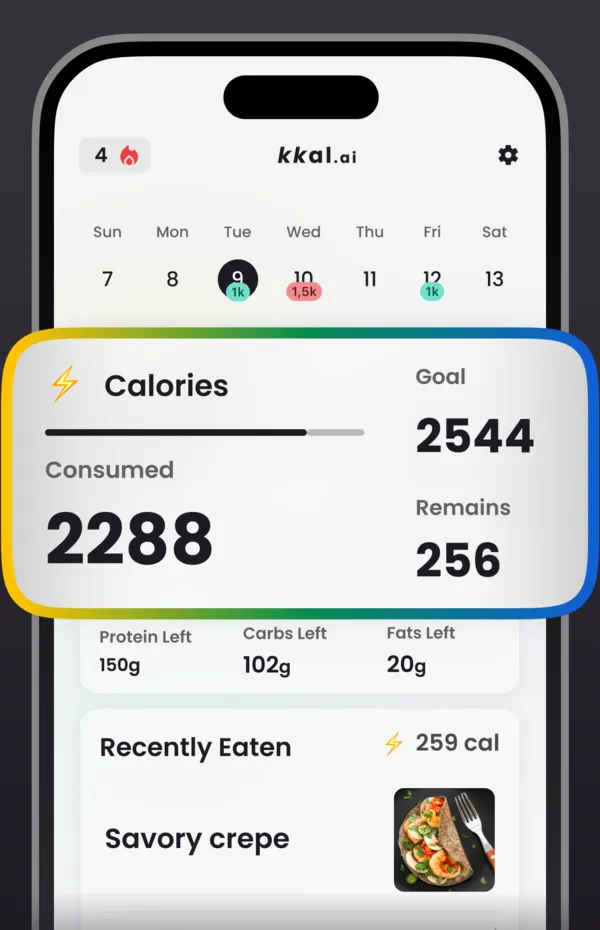
When men log honestly for the first time, the gap is rarely in the main meals. It tends to sit in a few places that are easy to forget:
- Drinks. Beer, wine, sweet coffee drinks and juice all count, and an evening out can add the calories of a full meal.
- Portions by eye. A plate of pasta or rice served at home can easily be bigger than the portion in the nutrition label. Weigh a few typical portions once so you know what yours look like.
- Cooking fat and sauces. Oil in the pan, butter on bread, mayonnaise and dressing are small in volume and high in calories.
- Weekends. Five careful days and two loose ones can cancel most of a week's deficit.
- Shakes and bars. Protein products help with protein, but they still have calories and belong in the log.
Belly fat, waist and protein
You cannot burn fat from one chosen spot, and no number of sit-ups changes that. The belly gets smaller when the whole body loses fat, which happens after weeks below maintenance, and plenty of men see their belt loosen before the scale shows much. The NHS suggests keeping your waist to less than half your height, and notes that losing just 5–10% of body weight can already improve health. Measure your waist around the navel once a week, on the same day.
- Keep protein high. Reviews of higher-protein diets for weight loss describe benefits at about 1.2–1.6 g per kg of body weight, which is 108–144 g a day at 90 kg. The protein guide has a table by goal.
- Keep lifting. Strength training two or three times a week helps you keep muscle while the weight goes down.
- Recalculate as you lose. Every 5–10 kg lost lowers your maintenance, and so does each birthday. Check the number again after each step.
When a calorie deficit is not the right plan
- Medical conditions and medication. If you have diabetes, heart disease or kidney disease, or take medication that affects appetite or blood sugar, agree on a target with your doctor first.
- An eating disorder, now or in the past. Counting calories can make it worse. Work with a health professional instead of an app.
- A healthy weight already. If you are in the healthy range and want to look leaner, a maintenance target with strength training may serve you better than a deficit.
- Warning signs. If you feel dizzy, weak in training or constantly exhausted, raise your calories and talk to a doctor.
Common mistakes
- Copying a 1,200 kcal plan meant for a small woman. For most men it is far too low and hard to keep.
- Counting weekdays carefully and leaving out weekends, beer and cooking oil.
- Eating back all the calories a fitness watch says you burned in the gym.
- Judging progress by one morning on the scale instead of a weekly average.
- Lowering calories every time the weight stalls, before checking whether the log is complete.