A calorie deficit means eating and drinking less energy than your body uses in a day. When intake stays below your daily needs, the body covers the gap from its stores, mostly body fat, and weight goes down over time. To set one up, estimate your maintenance calories (what you burn on an average day), then eat about 300–600 kcal below that. The NHS suggests cutting around 600 kcal a day as a safe and sustainable way to lose weight; a smaller cut is slower but often easier to keep up.
The calculation is the easy part. What decides the result is whether the deficit you planned is the deficit you actually eat, which is why a food diary matters more than the exact formula.
How to calculate your calorie deficit in four steps
- Estimate your resting energy (BMR). The Mifflin–St Jeor equation predicts it from weight, height, age and sex: for men 10 × weight (kg) + 6.25 × height (cm) − 5 × age + 5; for women the same with −161 at the end. The BMR calculator does this for you.
- Multiply by your activity level. Common factors are 1.2 for little exercise, 1.375 for light exercise 1–3 days a week, 1.55 for moderate exercise 3–5 days and 1.725 for hard exercise 6–7 days. The result is your maintenance estimate. The macro calculator adds the activity factor and splits the total into protein, carbs and fat.
- Subtract 300–600 kcal. That is your daily calorie target. Pick the lower end if you are active, close to your goal weight, or know that big restrictions make you give up.
- Test the number for two to three weeks. Log everything you eat and drink, weigh yourself under the same conditions (for example, in the morning before breakfast) and compare weekly averages instead of single days.
Choosing your activity factor honestly
The activity factor is where most estimates go wrong. It describes your whole week, not your best day: a desk job with three gym sessions is closer to light or moderate activity than to very active. If you are unsure between two levels, take the lower one. The two-week test in step 4 will show whether you guessed low, and it is easier to add food than to wonder why nothing changes.
Another way: start from what you eat now
If formulas feel abstract, the NHS describes a simpler route. Log a few typical days without changing anything, add up the calories, and cut about 600 kcal from that total. This works because your current intake, if your weight has been stable, is roughly your maintenance. It also shows you exactly where the calories come from, so you know what to trim.
Here is how it works out for two example people. Both numbers are estimates: formulas describe an average person, and your real maintenance can be a few hundred calories higher or lower.
| Example | BMR (Mifflin–St Jeor) | Maintenance | Target with −300 kcal | Target with −600 kcal |
|---|---|---|---|---|
| Woman, 35, 165 cm, 70 kg, light exercise (× 1.375) | about 1,395 kcal | about 1,920 kcal | about 1,620 kcal | about 1,320 kcal |
| Man, 40, 180 cm, 90 kg, moderate exercise (× 1.55) | about 1,830 kcal | about 2,840 kcal | about 2,540 kcal | about 2,240 kcal |
If you would rather see what a day at your target looks like than build it from scratch, the meal plans lay out full days with portions in grams, for example 1,600 kcal or 2,200 kcal.
Why the scale does not follow the math exactly
You will often read that a pound of fat equals 3,500 kcal (about 7,700 kcal per kilogram), so a 500 kcal daily deficit should take off exactly one pound a week, forever. Researchers who compared this rule with measured weight loss found that it overestimates the result, especially over longer periods. As you lose weight, your body needs less energy, so the same intake gradually becomes a smaller deficit. Models of human metabolism also show that the bodyweight response to a lasting change in intake is slow: it takes a long time to settle at a new stable weight.
Day-to-day weight also moves with water, salt, the contents of your gut and, for many women, the menstrual cycle. A salty restaurant meal or a hard new workout can push the number up overnight without any gain in fat, and it drifts back down a few days later. That is why single weigh-ins are noisy and the trend over two or three weeks is what tells you whether the deficit works. If the weekly average has not moved after three weeks of honest logging, lower the target by about 100–200 kcal or add some activity, then test again.
How to keep the deficit real
Most plans fail on the logging, not on the formula. The NHS advice on calorie counting lists the usual blind spots: drinks, alcohol, juices, the oil and spreads you cook with, toppings, and sauces such as mayo and ketchup. Portions are the other one. A pack of rice may list 260 kcal for a 75 g portion, but if your portion is 150 g, you are eating 520 kcal.
- Log as you eat, not at night. Entries made from memory miss snacks and second helpings.
- Weigh your usual portions once. After a week you will recognise what 150 g of rice or pasta looks like on your plate.
- Spread the cut over the day. The NHS example splits a 600 kcal reduction into about 100 at breakfast, 200 at lunch, 200 at dinner and 100 from snacks, rather than skipping one meal.
- Keep protein and vegetables on the plate. They make a smaller amount of food more filling. Set your protein target in the macro calculator.
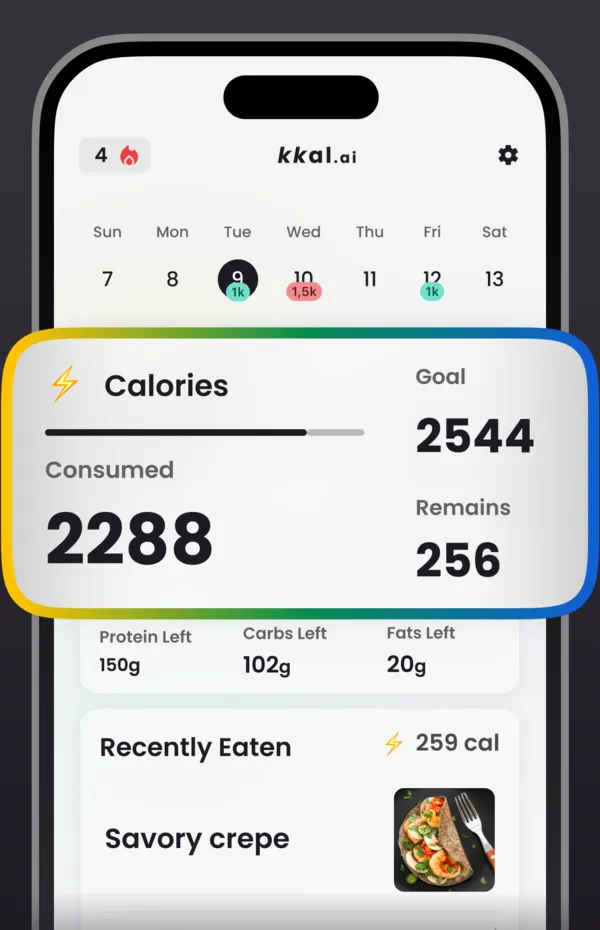
What to eat in a calorie deficit
No food is required or forbidden: weight change follows the total energy you eat over days and weeks. What changes in practice is how full you feel on fewer calories. Meals built around a protein source, vegetables and a measured portion of grains or potatoes usually keep you satisfied longer than the same calories from pastries, sweet drinks or fried snacks. Energy-dense extras are easy to underestimate: a spoonful of oil or a handful of nuts adds more than a large bowl of salad leaves.
You also do not need to eat the same thing every day. If dinner with friends is coming, eating a little lighter earlier in the day keeps the weekly total close to plan. What matters is the average over the week.
Recalculate as your weight changes
Your maintenance number is tied to your current weight. After you lose several kilograms, run the BMR calculation again with the new weight: the result will be lower, and keeping the old target would mean a smaller deficit than you think. Rechecking every 4–5 kg keeps the plan accurate. When you reach your goal, move your target back up to the new maintenance and keep an eye on the weekly average.
When not to set a deficit on your own
A calorie deficit is meant for adults who want to lose weight gradually. Talk to a doctor or a registered dietitian first if you are pregnant or breastfeeding, under 18, have diabetes or another condition that affects how you eat, take medication that depends on food intake, or have a history of disordered eating. If counting calories makes you anxious or obsessive, stop and get support; there are other ways to manage weight.
For a broader introduction to tracking itself, read the complete guide to calorie counting.