What is kcal? It's short for kilocalorie, a unit of energy equal to 1,000 small calories. In nutrition, kcal and "calories" are the same thing. A US label that says "Calories 250" and a European label that says "250 kcal" describe the same amount of energy. Older books spell it with a capital C, Calorie, and mean the same kilocalorie. Converted to kilojoules, one kcal is 4.184 kJ.
An app that shows 1,800 kcal for your day is talking about 1,800 ordinary calories. Nobody counts food in small calories. That number would be a thousand times bigger: 1,800,000 cal for an ordinary day.
kcal, Cal, cal and kJ: four names, two sizes
Physics has the small calorie, written cal. It's roughly the heat needed to warm 1 g of water by 1 °C. That's tiny, so food energy has always been measured in thousands of them. The NIST guide to SI units calls the "kilogram calorie" an obsolete name for the kilocalorie, the calorie used for the energy in foods, and notes that the "kilo" is usually dropped in everyday speech. That dropped "kilo" is the whole reason for the confusion.
| Written as | What it is | Where you see it | Equals |
|---|---|---|---|
| kcal | Kilocalorie | EU, UK and many other labels; apps; fitness trackers | 1,000 cal, 4.184 kJ |
| Calories, Cal | Kilocalorie under another name | US and Canadian labels, menus, recipes | 1 kcal |
| cal | Small calorie | Physics and chemistry; almost never on food | 0.001 kcal, 4.184 J |
| kJ | Kilojoule, the SI unit of energy | EU labels next to kcal; Australia and New Zealand | 0.239 kcal |
When an app, a meal plan or a label says "calories" about food, read it as kcal. The only time it really matters is when you meet a number in kJ, because that one is about four times bigger.
How to convert kcal to kJ and back
The factor is 4.184. FAO, the food agency of the United Nations, uses exactly this: 1 kcal = 4.184 kJ, and 1 kJ = 0.239 kcal. Some engineering tables give 4.1868 instead. The difference is under 0.1%, so for food it doesn't matter which one you pick.
- Going from kcal to kJ, multiply by 4.184. A 2,000 kcal day comes to 8,368 kJ.
- Going back from kJ, divide by 4.184 (or multiply by 0.239). A snack bar with 840 kJ has about 201 kcal.
- In your head, 4 is close enough: kcal times 4, or kJ divided by 4. That's about 5% off. Good for a shop shelf, too rough for a diary.
| kcal | kJ | For scale |
|---|---|---|
| 100 kcal | 418 kJ | A small snack |
| 250 kcal | 1,046 kJ | A light breakfast |
| 500 kcal | 2,092 kJ | A typical main meal |
| 1,000 kcal | 4,184 kJ | Half of a 2,000 kcal day |
| 1,500 kcal | 6,276 kJ | A common weight-loss target |
| 2,000 kcal | 8,368 kJ | The reference day on US labels |
The 2,000 in the last row is the FDA's general guide for nutrition advice, not a personal target. Your own number depends on your size, age and how much you move. Work it out in how many calories you need per day or with the BMR calculator.
Where the kcal on a label come from
No one burns every product in a lab. The number on the pack is usually calculated from the protein, carbohydrate and fat in it, using fixed factors per gram. FAO lists the general ones, and EU Regulation 1169/2011 makes them the rule for European labels:
- Protein: 4 kcal (17 kJ) per gram.
- Carbohydrate: 4 kcal (17 kJ) per gram.
- Fat: 9 kcal (37 kJ) per gram.
- Alcohol: 7 kcal (29 kJ) per gram.
- Fibre: 2 kcal (8 kJ) per gram on EU labels. Polyols, the sugar alcohols in sugar-free sweets, count 2.4 kcal per gram.
Try it on a 150 g pot of plain Greek yogurt with 15 g protein, 6 g carbohydrate and 3 g fat. That's 15 × 4 + 6 × 4 + 3 × 9 = 60 + 24 + 27 = 111 kcal. If the label says 110 or 113, the gap is rounding. The same sum explains why fatty foods are so dense in energy. A gram of fat brings more than twice the kcal of a gram of sugar or protein. If you want to see the split for your whole day, the macro calculator turns a calorie target into grams.
Two more things to look for on the pack. European labels give energy per 100 g or 100 ml and must show it in both kJ and kcal, which is why you see "1046 kJ / 250 kcal". US labels give Calories per serving, and the serving is set by the maker. A bag of crisps with "150 Calories" may hold three servings. Check the serving size before you write the number down.
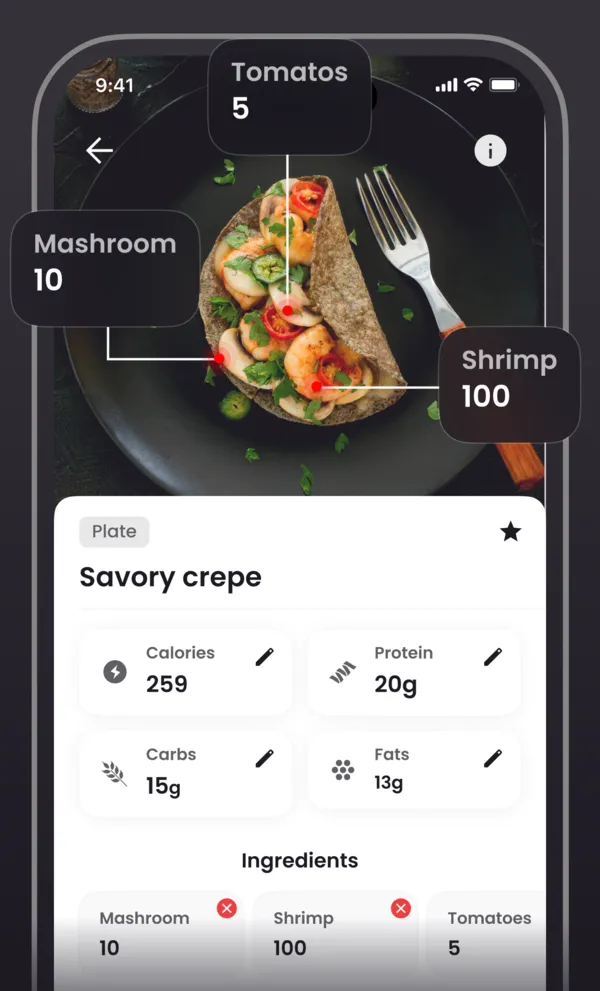
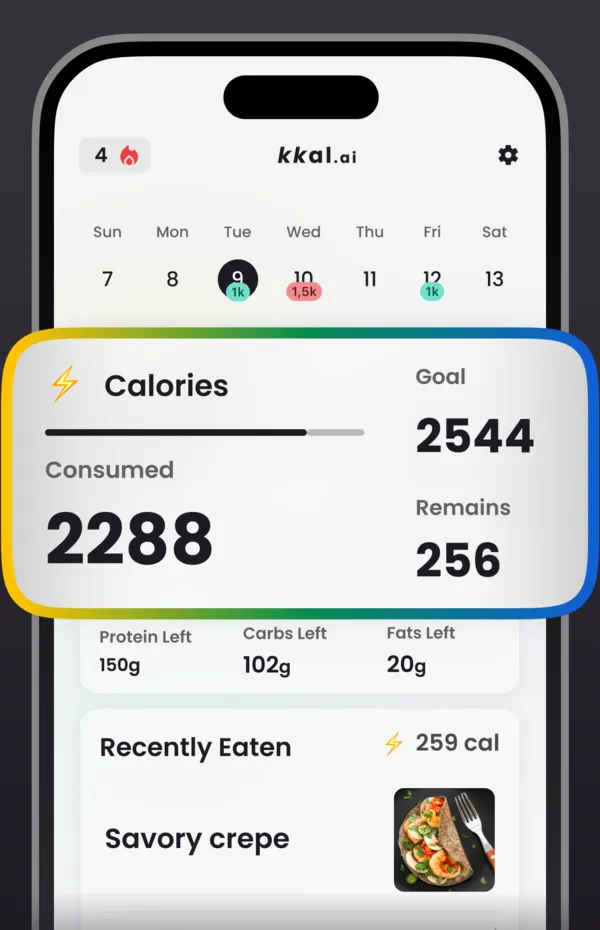
kcal on a smartwatch, treadmill or scale
Half of what people type after "kcal meaning" has to do with devices. The unit is the same there: a watch that shows 320 kcal for a walk means 320 of the same calories that are on your yogurt. What differs is how the number is made.
- Active kcal on a watch are the extra energy spent moving. Total kcal add your resting energy, the part you'd burn lying on the sofa.
- Treadmills and bikes estimate kcal from speed, incline and the weight you entered. If you never entered your weight, the machine uses a default.
- Smart scales that show kcal usually display an estimate of your resting needs from your weight, height and age.
All of these are estimates, not measurements. They're useful for comparing one week with the next. Eating back every burned kcal is risky, though. If the estimate runs high, the deficit you planned quietly disappears.
What kcal mean for your weight
Weight changes with the balance between the kcal you eat and the kcal you spend. Eat less than you spend and the body covers the gap from its stores. That gap is the calorie deficit, and it's counted in kcal per day. The kcal in a kilogram of body fat are a separate story, with their own table.
Where people go wrong is rarely the unit. It's the inputs. Portions are bigger than they think, the oil in the pan goes unnoticed, and a kJ figure gets copied as kcal. Browse a calorie chart of everyday foods once and the numbers stop feeling abstract. If you'd rather not plan from scratch, the 1,500 kcal meal plan shows what a full day at that level looks like.