A kilogram of body fat holds about 7,700 kcal. In pounds it is the well-known 3,500 kcal per pound, the same number in other units. So to lose 1 kg of fat you need to eat roughly 7,700 kcal less than you burn, spread over days or weeks. With a deficit of 500 kcal a day that takes about 15 days.
Pure fat has more: 9 kcal per gram, or 9,000 kcal per kilogram. Body fat is not pure fat, though. The tissue also holds water and a little protein, which is why its kilogram comes out lower. And 7,700 is an estimate, not a law. It works well for the first weeks and then starts to promise more than the scale shows. Why that happens is explained below.
How many calories are in 1, 2, 5 and 10 kg of fat
The math is one multiplication: kilograms times 7,700. For the other direction, divide the calories by 7.7 and you get grams of fat.
| Body fat | Energy, kcal | Days at a 500 kcal deficit |
|---|---|---|
| 100 g | 770 | 1.5 |
| 0.45 kg (1 lb) | 3,500 | 7 |
| 1 kg | 7,700 | 15 |
| 2 kg | 15,400 | 31 |
| 3 kg | 23,100 | 46 |
| 5 kg | 38,500 | 77 |
| 10 kg | 77,000 | 154 |
A few conversions people often ask about. 400 kcal is about 52 g of fat. 1,000 kcal is about 130 g. 2,500 kcal, a full day of food for many men, is about 325 g. One heavy dinner cannot add a kilogram of fat overnight. If the scale is up 1 kg the next morning, most of that is water and the food itself.
Where the 7,700 kcal rule comes from
The figure goes back to a 1958 paper in the American Journal of Clinical Nutrition that estimated the energy in a pound of lost weight at 3,500 kcal. Converted to metric units that is 32.2 MJ per kilogram, or about 7,700 kcal. The rule is simple, so it spread to textbooks, diet plans and apps.
Kevin Hall, a researcher at the US National Institutes of Health, checked in 2008 when the rule holds. His answer: it fits people who start with more than about 30 kg of body fat. For leaner people the number is too high. They lose more lean tissue along with the fat, and lean tissue holds much less energy per kilogram. A lean person may see the scale drop by a kilogram after a smaller deficit than 7,700 kcal, but not all of that kilogram is fat.
How much weight a daily deficit gives
Take your daily deficit, multiply by the number of days and divide by 7,700. The table shows what the rule predicts for common deficits. Treat it as the best case for the first one or two months.
| Deficit per day | Per week | Per 30 days | Days per 1 kg |
|---|---|---|---|
| 250 kcal | 0.23 kg | 1.0 kg | 31 |
| 300 kcal | 0.27 kg | 1.2 kg | 26 |
| 500 kcal | 0.45 kg | 1.9 kg | 15 |
| 750 kcal | 0.68 kg | 2.9 kg | 10 |
| 1,000 kcal | 0.91 kg | 3.9 kg | 8 |
The NHS advises aiming for 0.5 to 1 kg a week, which is 1 to 2 lb. In the table that is the range from 500 to 1,000 kcal a day. The upper end is hard to hold unless your maintenance calories are high. For most people 300–500 kcal is the range they can live with for months. How to choose the size is covered in the guide to a calorie deficit.
Plan your own weight loss in 5 steps
- Find your maintenance calories. Use the BMR calculator and your activity level, or see the table in how many calories you need per day.
- Pick a deficit. Start with 300–500 kcal below maintenance.
- Turn it into kilograms. Deficit × 7 ÷ 7,700 is the expected loss per week. At 500 kcal it is about 0.45 kg.
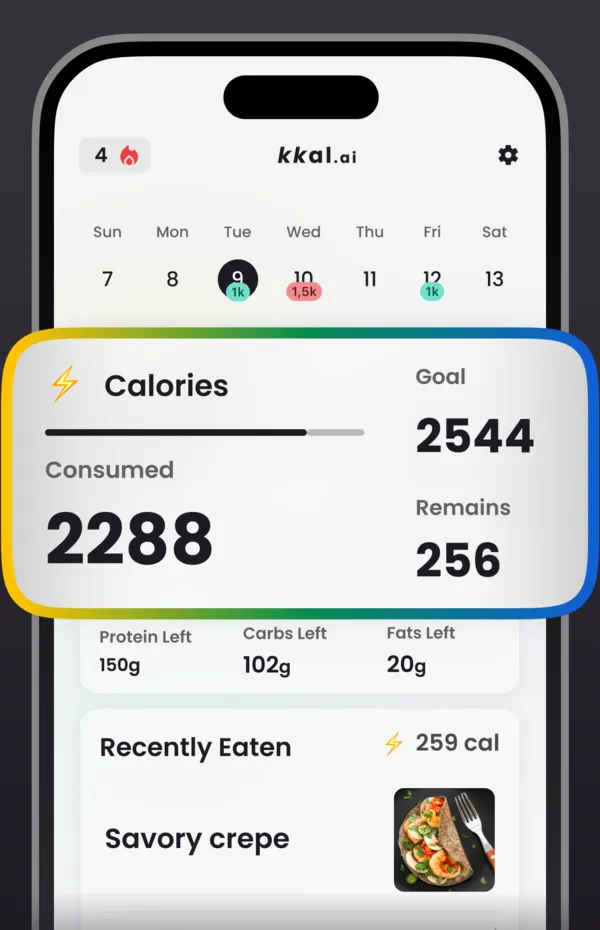
- Log what you eat and weigh yourself. Same scale, in the morning. Look at the weekly average, since single days jump around.
- Compare after 2–3 weeks. If the average moves slower than planned, check portions, oil and drinks first. Then recalculate maintenance for your new weight.
An example. A woman weighs 80 kg and maintains at about 2,100 kcal. She eats 1,600 kcal, so the deficit is 500 kcal a day. The rule gives 0.45 kg a week and 5 kg in 77 days, which is 11 weeks. In practice the last kilograms come slower, and 13–14 weeks is a more honest plan.

Why the scale does not follow the formula
The rule assumes your body burns the same amount every day no matter how much you weigh. It does not. A lighter body needs less energy to move and to keep itself going. The same 1,600 kcal that was a 500 kcal deficit at 80 kg is a smaller deficit at 72 kg. Weight loss slows down and then stops, even if you eat exactly the same.
Hall and colleagues described this in The Lancet in 2011. Their model follows a sedentary man of 100 kg who cuts 480 kcal a day and keeps it there. He ends up at about 75 kg. Half of that loss takes about a year, and 95% of it about three years. The simple rule would promise him almost 23 kg in the first year alone and no end after that.
From the same paper comes a slower but more realistic rule for the long run: every 10 kcal a day you cut permanently leads to about one pound (0.45 kg) of weight change in the end. So 500 kcal a day is worth about 50 lb, or 23 kg, if you hold it for years, and half of it arrives in the first year. The NIH Body Weight Planner, a free online calculator, is built on this model and shows a curve for your own numbers.
Day to day the scale also moves for reasons that have nothing to do with fat. Salt, a late dinner, a hard workout and the menstrual cycle can shift it by a kilogram or more. This is why a weekly average tells you more than any single morning.
Can you burn 7,700 kcal in a day or a week?
In a day, no. Most adults use between 1,600 and 3,000 kcal a day in total, so 7,700 kcal is several days of all the energy you spend. Even with no food at all you would not get there, and fasting like that is unsafe.
In a week it is possible on paper: 1,100 kcal a day. For most people that is too deep. A cut this size tends to leave you hungry and tired and it costs muscle. Most people do better splitting the work, for example 400 kcal less food and a 30–40 minute walk. The week-by-week routine is in how to lose weight by counting calories.
If you want a ready menu at a set level, see the 1,500 kcal meal plan. A food diary helps you see whether the deficit you planned is the one you actually eat.
Common mistakes
- Treating 7,700 as exact. It is an average for body fat. What you lose is a mix of fat, water and some lean tissue.
- Judging by one weigh-in. A kilogram up or down in a day is water, not 7,700 kcal.
- Keeping the old calorie target. After every 4–5 kg lost, your maintenance is lower. Recalculate.
- Counting exercise calories too generously. Watches and machines often show more than you burned. If you eat all of it back, the deficit is gone.
- Going too low. A very large deficit is hard to keep and easy to rebound from. If you have a medical condition, are pregnant or are under 18, talk to a doctor before cutting calories.