How much weight can you lose in a week? Realistically, 0.5–1 kg (1–2 lb) of fat. That's the pace the NHS recommends, and it takes a daily calorie deficit of about 500–1,100 kcal. The scale may show more in the first week, sometimes 1–3 kg, but most of that extra is water and the food in your gut, not fat. It comes back as soon as you eat normally again.
So there are two numbers: the one on the scale and the fat you really lost. Further down you'll find why they differ, a table with fat loss for each daily deficit, and a one-week plan where you still eat three meals.
Why the first week shows more on the scale
Carbs you don't use right away sit in the liver and muscles as glycogen. Glycogen is heavy with water: a review in the American Journal of Clinical Nutrition describes three to four parts water for every part glycogen. When you eat less, and especially fewer carbs, the body uses that reserve first, and the water goes with it.
Two more things add to the early drop. You eat less food, so there is less of it in your stomach and intestines at any moment. And if you cut out bread, sauces and snacks, you usually eat less salt, so your body holds less water. None of this is fat. That's why diets that promise 5 kg in 7 days can show a big number on day seven, and why it comes back after a pizza.
This isn't a reason to ignore the scale. It's a reason to expect the first week to look better than the following ones, and not to panic when week two shows only 0.5 kg.
How much fat you lose per week, by daily deficit
One kilogram of body fat is worth roughly 7,700 kcal (more on that number in how many calories are in a kg of fat). Take the deficit you held for a week, divide it by 7,700, and you have a rough figure for the fat that went:
| Daily deficit | Deficit per week | Fat lost per week (estimate) |
|---|---|---|
| 250 kcal | 1,750 kcal | about 0.23 kg (0.5 lb) |
| 500 kcal | 3,500 kcal | about 0.45 kg (1 lb) |
| 750 kcal | 5,250 kcal | about 0.68 kg (1.5 lb) |
| 1,000 kcal | 7,000 kcal | about 0.9 kg (2 lb) |
| 1,100 kcal | 7,700 kcal | about 1 kg (2.2 lb) |
Treat this as a guide for the first weeks, not a promise for the whole year. A model of human metabolism published in The Lancet in 2011 found that weight reacts to eating less slowly, with half times of about a year. As you get lighter you burn a bit less, so the same menu gives smaller drops later on. To work out your deficit in the first place, start with how many calories you need per day, then read about choosing the calorie deficit itself.
Can you lose 5 or 10 kg in a week?
Not as fat. The arithmetic is short. Losing 10 kg of fat would take about 77,000 kcal, or 11,000 kcal a day for seven days. The NHS puts average daily use at around 2,000 kcal for women and 2,500 kcal for men. Even someone who ate nothing at all for a week would burn 14,000–17,500 kcal, which is about 2 kg of fat at most.
So when someone reports 5 kg in a week, most of it is water, glycogen and the contents of the gut, and on a very harsh diet, some muscle too. That weight returns quickly, and losing muscle makes the next attempt harder, not easier.
How to lose weight in a week without starving
One week is enough to set up the habit that makes the next ten work. Here's a plan for it:
- Find your maintenance number. Use the calories-per-day guide or the BMR calculator plus your activity level.
- Take off 500–750 kcal. On 2,200 kcal maintenance, that's 1,450–1,700 kcal a day. Women shouldn't go below about 1,200 kcal, men below about 1,500, without a doctor.
- Keep protein high. Put a portion of meat, fish, eggs, cottage cheese, Greek yogurt or legumes in every meal. It keeps you fuller and helps protect muscle while you eat less.
- Cut the calories you drink. Juice, soda, sweet coffee drinks and alcohol add a lot without filling you up. Swapping them for water or unsweetened tea is the easiest 200–400 kcal to lose.
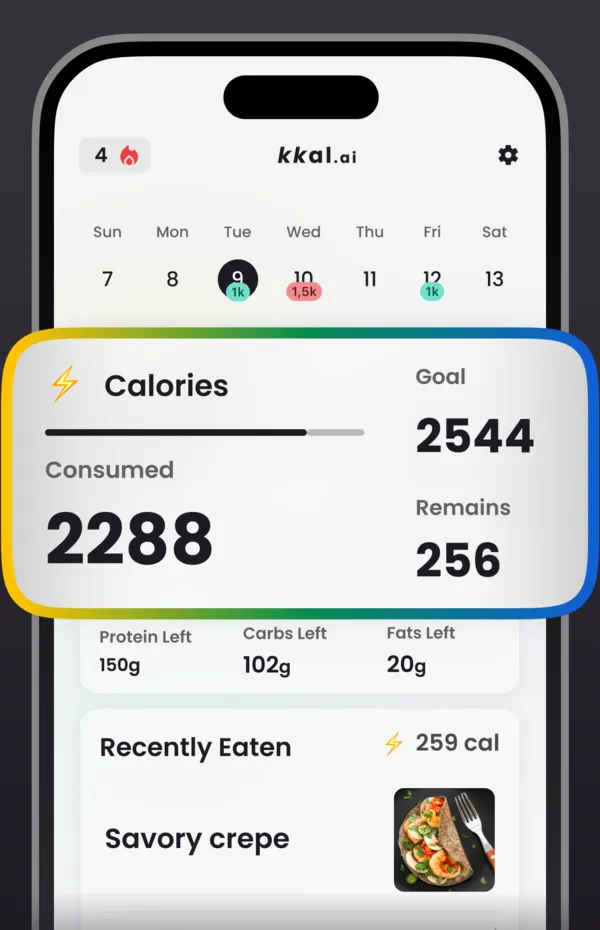
- Log everything for seven days. Including oil, sauces and bites while cooking. Without a log, a 500 kcal deficit can disappear in two handfuls of nuts.
- Weigh yourself the same way. Morning, after the toilet, before breakfast, same clothes. Compare the average of this week with the average of the next, not Monday with Tuesday.
If you'd like a ready menu instead of building one, there's a 7-day weight loss meal plan with the calories worked out for every meal.

How to read the scale during the week
Morning weight moves with salt, water, carbs, the time you last ate and, for many women, the menstrual cycle. A heavy salty dinner can add half a kilo overnight that has nothing to do with fat. One reading tells you very little.
A simple fix: weigh every morning, write the number down, and look at the weekly average. If the average falls by about 0.5–1 kg from one week to the next, the plan is working. If it hasn't moved for two or three weeks while you've logged honestly, take another 100–200 kcal off or add a daily walk.
When losing weight fast is a bad idea
Crash diets do more than disappoint. The NIDDK, part of the US National Institutes of Health, notes that losing weight very quickly may raise your chances of forming gallstones. Very low calorie diets, roughly 800 kcal a day or less, are meant to be used under medical supervision, not on your own because of an event next weekend.
Talk to a doctor before cutting calories if you're pregnant or breastfeeding, take insulin or other blood-sugar-lowering medicine, have kidney disease, or have a history of an eating disorder. For everyone else, the slower pace is the one that holds: 0.5–1 kg a week adds up to 2–4 kg in a month, and that weight is mostly fat.