Intermittent fasting helps with weight loss mostly because a shorter eating day usually means eating less. The hours alone do little. When researchers gave two groups the same calorie limit, people who ate within 8 hours lost about as much as people who ate from morning to night. Calories still count on intermittent fasting; the window is one way of keeping them down.
So if fasting suits you, it is a fine tool. Many people drop breakfast and eat from noon to 8 pm. The catch is dinner: if the missed breakfast comes back in the evening, the scale stays where it was. That is why the sample day further down lists calories for each meal, not only the times.
Intermittent fasting schedules at a glance
The two numbers show hours of fasting and hours of eating. 16:8 means 16 hours without calories and an 8-hour eating window. Sleep covers most of the fast.
| Schedule | Eating window | Example times | Who it suits |
|---|---|---|---|
| 12:12 | 12 hours | 8:00–20:00 | A first step: no late snacks |
| 14:10 | 10 hours | 10:00–20:00 | Easier start, breakfast moves a little later |
| 16:8 | 8 hours | 12:00–20:00 | The most common plan; breakfast is skipped |
| 18:6 | 6 hours | 13:00–19:00 | Two meals a day, for people already used to 16:8 |
| 20:4 | 4 hours | 15:00–19:00 | Hard to get enough protein; not a starting point |
| 5:2 | Every day, but two low days | About 500–600 kcal on two days a week | People who prefer two hard days to daily limits |
A shorter window is not automatically better. Pick the one you can keep on workdays and weekends. If 16:8 leaves you hungry and grumpy every afternoon, 14:10 with a counted deficit gives the same result.
What the studies show
Three randomised trials answer the question most people have: does fasting burn more fat than ordinary calorie counting?
In China, 139 adults with obesity spent a year on the same calorie limit: 1,500–1,800 kcal for men and 1,200–1,500 kcal for women. On top of that, half of them ate only between 8 am and 4 pm. After 12 months the fasting group had lost 8.0 kg and the other group 6.3 kg. The gap was not statistically significant (NEJM, 2022).
The US TREAT trial tested 16:8 on its own, with no calorie advice. 116 adults ate from noon to 8 pm for 12 weeks; a control group ate three meals a day. Weight loss was small in both groups, under 1 kg, and almost the same (JAMA Internal Medicine, 2020).
A third trial compared eating from noon to 8 pm without counting against a 25% calorie cut. Both groups ate about 400 kcal a day less than before and lost a similar amount over a year (Annals of Internal Medicine, 2023).
The three trials point the same way. Fasting works when it lowers intake. On the same calorie deficit it gives no extra fat loss. Some people find a window easier than counting every snack, others find the long morning hard. Both routes end at the same energy balance, the one behind any calorie deficit.
How to do 16:8 and still count calories
- Find your daily calories. Work out your maintenance with the BMR calculator, or check the table in how many calories you need per day. Subtract 300–500 kcal for weight loss.
- Choose a window you can keep. Noon to 8 pm fits most work days. Keep the same hours on weekends if you can.
- Split the calories over two or three meals. In an 8-hour window that is lunch, an afternoon snack and dinner. See calories per meal for a simple split.
- Put protein in every meal. With fewer meals it is easy to fall short. Aim for 25–40 g per meal; the guide on protein per day has the targets by weight.
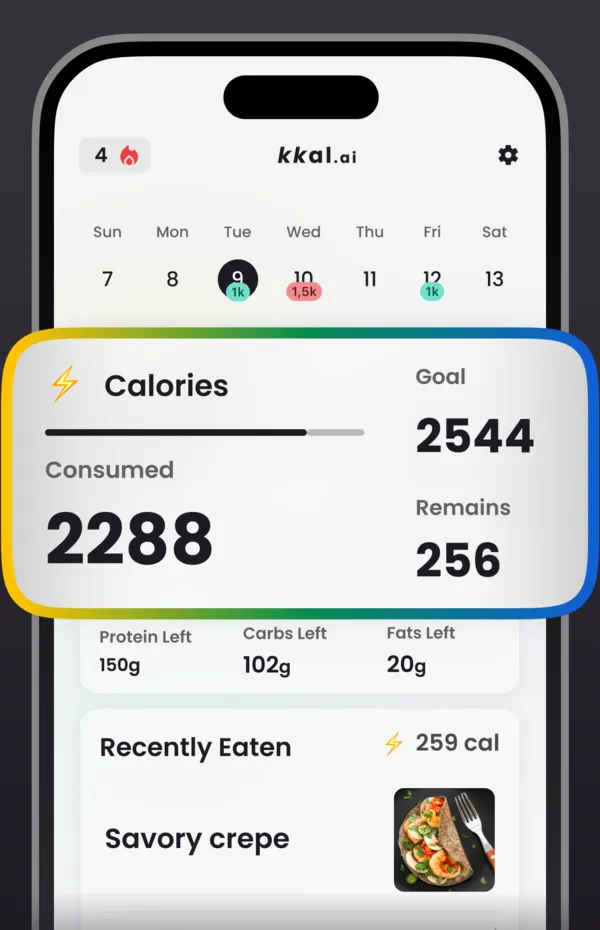
- Log everything you eat in the window. Large meals hide calories in oil, sauces and second helpings.
- Judge by the weekly average. Weigh yourself in the morning and compare weeks, not days.
Example 16:8 day at about 1,460 kcal
This day fits an eating window from 12:00 to 20:00. The numbers are approximate and depend on brands and portions, so check the labels on your own food.
| Time | Meal | Calories |
|---|---|---|
| Before 12:00 | Water, black coffee or plain tea | 0–5 kcal |
| 12:30 | 150 g cooked chicken breast, 150 g cooked rice, vegetables with 1 tbsp olive oil | about 600 kcal |
| 16:00 | 200 g plain Greek yogurt, 1 apple, 15 g walnuts | about 340 kcal |
| 19:30 | 3-egg omelette with vegetables, 30 g cheese, 2 slices wholegrain bread | about 520 kcal |
| Total | About 100 g of protein | about 1,460 kcal |
For a higher target, add a portion to lunch or dinner rather than a fourth meal. Ready menus with gram weights are in the 1,500 kcal meal plan; any of its meals fit an 8-hour window.

What breaks a fast
Anything with calories ends the fast. Water, sparkling water, black coffee and plain tea do not. A splash of milk adds 10–20 kcal; it hardly changes weight loss, but it is no longer a strict fast. Juice, sweet coffee drinks, smoothies and alcohol all count as food. A large latte can have more calories than a small breakfast.
Why intermittent fasting stops working
- Dinner grows to fill the gap. The skipped breakfast comes back as a bigger evening meal and snacks after it.
- The first meal is a reward. After 16 hours, fast food and sweets look like a fair deal. The total for the day ends up at maintenance.
- Calories in drinks. Sugar and milk in coffee, juice and beer are easy to forget.
- Too little protein. Two meals with little protein leave you hungry and make it harder to keep muscle.
- Weekend breaks. A late brunch and a late dinner turn the window into 12 hours twice a week.
If the weekly average has not moved in three weeks, log every meal for a week and add it up. Most stalls show up in the numbers within a few days.
Who should not fast without a doctor
Long gaps between meals are not for everyone. During pregnancy and breastfeeding the body needs steady food, so fasting is not the moment. With type 1 diabetes, or on insulin and other drugs that lower blood sugar, a skipped meal can drop sugar too far; the doctor has to adjust the plan first. People who once had an eating disorder often find that strict hours bring old habits back. Teenagers under 18 should not fast for weight loss at all. And if you have a chronic illness, or you get dizzy and weak in the morning, ask your doctor before you try. In all of these cases regular meals with a small deficit are the safer way.