How much sugar per day is OK? The World Health Organization's answer is less than 10% of your calories from free sugars. On 2,000 kcal that's 50 g, about 12 level teaspoons. Getting down to 5%, or 25 g, may do you more good. The limit covers the sugar that's added to food and drinks, plus honey, syrups and fruit juice. Whole fruit, vegetables and plain milk aren't part of it.
The American Heart Association is stricter. It suggests no more than 100 calories a day from added sugar for most women and 150 for most men. That's about 25 g and 38 g. So where does your own day land? One can of cola holds 33 g, which is why most people find out only when they add it up.
How many grams of sugar per day by calories
Sugar has 4 kcal per gram. To turn the WHO percentages into grams, take 10% (or 5%) of your daily calories and divide by 4. A level teaspoon holds about 4 g, so dividing the grams by 4 again gives you teaspoons.
| Calories a day | Free sugars, less than (10%) | In teaspoons | Lower target (5%) |
|---|---|---|---|
| 1,400 kcal | 35 g | about 9 | 18 g |
| 1,600 kcal | 40 g | about 10 | 20 g |
| 1,800 kcal | 45 g | about 11 | 23 g |
| 2,000 kcal | 50 g | about 12 | 25 g |
| 2,200 kcal | 55 g | about 14 | 28 g |
| 2,400 kcal | 60 g | about 15 | 30 g |
| 2,600 kcal | 65 g | about 16 | 33 g |
Eating 1,600 kcal to lose weight? Then your ceiling is 40 g, not the 50 g you see quoted everywhere, and the lower target is 20 g. Not sure about your calories yet? Start with how many calories you need per day.
What counts as sugar and what doesn't
This is the part people get wrong most often. The limit is about free sugars, the WHO's term, and it isn't the same thing as the "sugars" line on a label.
- Counts: sugar you add to tea, coffee, porridge or baking. Sugar a manufacturer puts into drinks, sweets, yogurt, sauces and cereal. Honey and syrups. Fruit juice, even when the carton says "no added sugar".
- Doesn't count: the sugar inside whole fresh fruit and vegetables, and the lactose in plain milk and plain yogurt.
A label lists total sugars, so a plain yogurt shows about 5 g per 100 g and none of it is free sugar. A fruit yogurt shows about 19 g, and only the part above those 5 g was added. US labels make this easier with a separate "Added Sugars" line. On other labels, look at the ingredients: sugar, glucose-fructose syrup, honey, juice concentrate and anything ending in "-ose" all count.
How to count your sugar in 4 steps
- Find your limit. Example: 2,000 kcal a day. Ten percent is 200 kcal, or 50 g. Five percent is 25 g.
- Write down the sweet drinks first. Sugar in coffee and tea, soda, juice, energy drinks. A teaspoon is 4 g, and a 330 ml can of cola is 33 g.
- Add the sweetened foods. Read "sugars per 100 g" on the label and multiply by what you ate. For dairy, subtract the 5 g per 100 g that's milk sugar.
- Compare and change the biggest item. One swap in drinks usually saves more than a week of skipping dessert.
Here's a day that doesn't look sweet at all, and the same day after three small changes:
| What you had | Added sugar | Swap | After |
|---|---|---|---|
| Two coffees with 2 teaspoons of sugar each | 16 g | One teaspoon in each | 8 g |
| Fruit yogurt, 150 g | 22 g | Plain yogurt with a banana | 0 g |
| Can of cola, 330 ml | 33 g | Water or a zero-sugar drink | 0 g |
| Milk chocolate, 25 g | 13 g | The same 25 g | 13 g |
| Ketchup, 1 tablespoon | 4 g | The same tablespoon | 4 g |
| Total | 88 g | 25 g |
Before the swaps it's 88 g. That's about 350 kcal, or 18% of a 2,000 kcal day, and nobody ate a cake. After them it's 25 g, right on the lower WHO target, and the chocolate is still there.
Sugar in common foods and drinks
The numbers below are total sugars from USDA FoodData Central. The last column says whether that sugar goes toward your daily limit. "Mostly" and "partly" mean some of it is milk sugar or comes from the tomatoes. Drinks are counted as 1 ml = 1 g.
| Food | Sugars per 100 g | Usual portion | Sugars in the portion | Counts toward the limit? |
|---|---|---|---|---|
| Granulated sugar | 99.8 g | 1 level teaspoon, 4 g | 4 g | Yes |
| Honey | 82.1 g | 1 teaspoon, 7 g | 6 g | Yes |
| Sweetened condensed milk | 54.4 g | 1 tablespoon, 20 g | 11 g | Mostly |
| Milk chocolate | 51.5 g | 25 g, a quarter of a bar | 13 g | Mostly |
| Jam | 48.5 g | 1 tablespoon, 20 g | 10 g | Yes |
| Chocolate chip cookies | 32.9 g | 30 g, two or three cookies | 10 g | Yes |
| Dark chocolate, 70–85% cacao | 24.0 g | 25 g | 6 g | Yes |
| Ketchup | 21.3 g | 1 tablespoon, 17 g | 4 g | Mostly |
| Vanilla ice cream | 21.2 g | 70 g, one scoop | 15 g | Mostly |
| Fruit yogurt, low-fat | 19.0 g | 150 g cup | 29 g | Partly |
| Cola | 9.9 g | 330 ml can | 33 g | Yes |
| Apple juice, unsweetened | 9.6 g | 250 ml glass | 24 g | Yes |
| Orange juice, fresh | 8.4 g | 250 ml glass | 21 g | Yes |
| Banana | 12.2 g | 120 g, one medium | 15 g | No |
| Apple | 10.4 g | 180 g, one medium | 19 g | No |
| Milk, whole | 5.1 g | 200 g glass | 10 g | No |
| Plain yogurt, whole milk | 4.7 g | 150 g cup | 7 g | No |
Look at the two juices. A glass has 21–24 g of sugar, close to the 33 g in a can of cola, and the WHO counts juice as free sugar even without anything added. A whole apple has almost as much sugar as the glass of juice, but it's outside the limit. You get fibre with it, too, and it takes longer to eat.
How much sugar per day to lose weight
Is quitting sugar the price of losing weight? No. Sugar moves your weight through its calories and nothing else. In a review of trials done for the WHO, adults told to cut back on sugars, with no other diet rules, lost 0.80 kg on average. People told to eat more of it gained 0.75 kg. And when sugar was swapped for the same calories from other carbs, weight didn't change.
So treat sugar as the easiest calories to remove:
- Set your calorie deficit first, then find 10% of that lower number. On 1,600 kcal it's 40 g.
- Start with drinks. A drink won't fill you up, and one can of cola is about 140 kcal.
- Keep one sweet thing you really like and weigh it. 25 g of milk chocolate is 13 g of sugar, and that fits.
- Don't swap sugar for "healthy" honey or juice and expect a different result. They count just the same.
- Sugar is a carbohydrate, so it's already inside your carb number. See how many carbs per day and the macro calculator.
Fruit isn't the problem here. Two or three pieces a day fit almost any plan, and several of them are on the list of low-calorie foods.
Sugar per day for women, men and children
The WHO gives one rule for everyone, adults and children alike: under 10% of energy, better 5%. The grams differ only because the calories do. A woman eating 1,800 kcal has a 45 g ceiling, and a man eating 2,400 kcal has 60 g. A child eats fewer calories, so the same percentage means fewer grams. The American Heart Association numbers, 100 and 150 calories, already come split by sex.
One more thing. These limits are written for healthy people. Do you have diabetes or prediabetes? Then total carbohydrates matter and not only sugar, and the amounts should come from your doctor or dietitian, not from this table.
How to keep track without doing sums all day
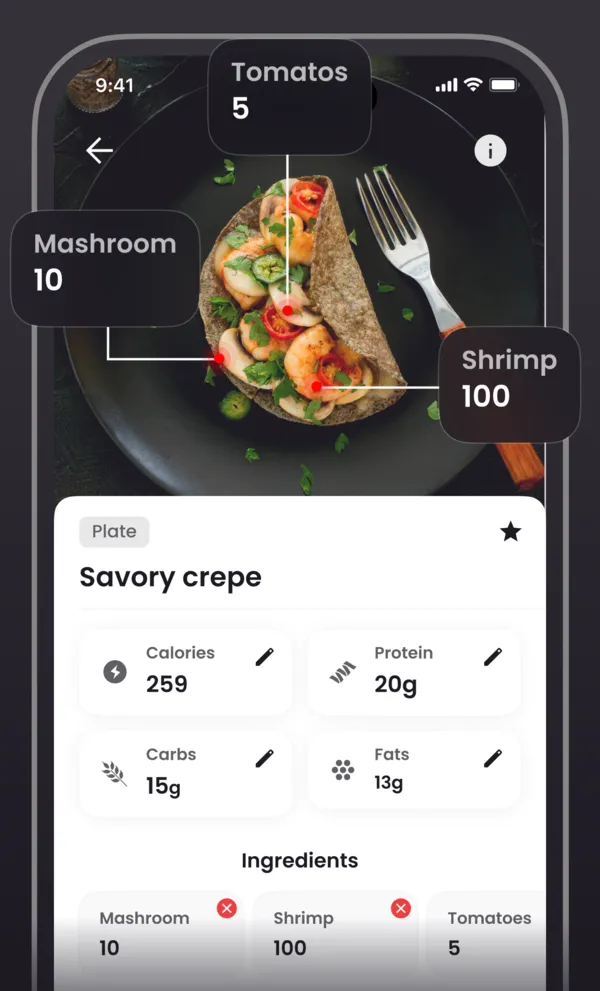
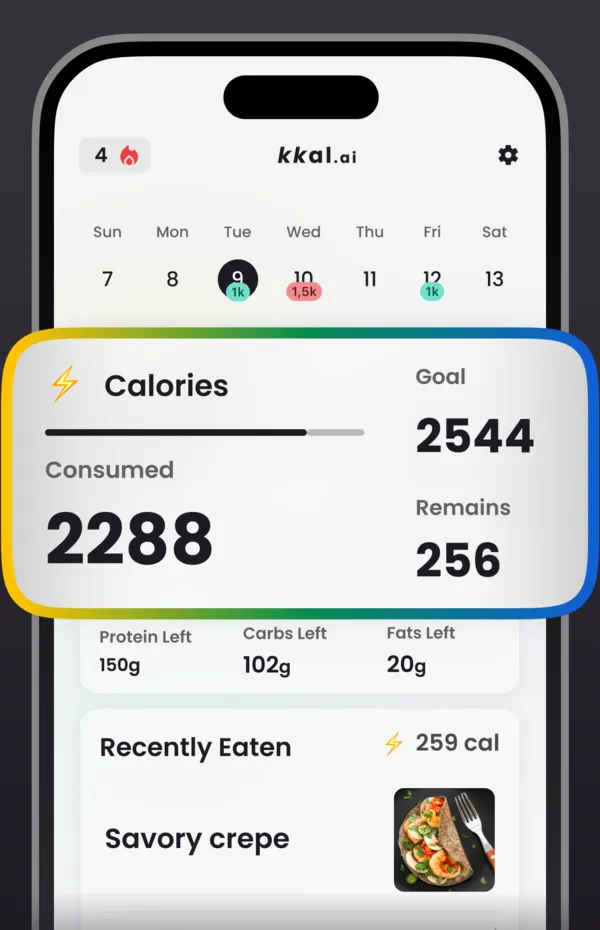
You don't have to count sugar forever. Two weeks of honest logging usually shows where it comes from, and for most people it's two or three items. A food diary works on paper or in an app. Log everything you drink as well as what you eat, because that's where the grams hide. Once the big sources are fixed, the rest tends to stay under the limit without daily arithmetic.