To count macros, you track how many grams of protein, fat and carbohydrates you eat in a day, not only the calories. (In Russian-speaking countries this is called КБЖУ: calories, protein, fat and carbs.) The method has four parts: set a daily calorie target, split it into grams of each macro, weigh or estimate what you eat and look up its values per 100 g, then add the day up and compare it with your targets. The conversion is simple: one gram of protein or carbohydrate gives about 4 kcal, and one gram of fat about 9 kcal.
You do not need to hit every gram exactly. Getting close to your protein target and keeping fat and carbs roughly in range over the week is what makes the numbers useful.
How to count macros in five steps
- Find your daily calories. Estimate your maintenance from weight, height, age, sex and activity in the macro calculator. If you want to lose weight, set a moderate calorie deficit first; the macros are then shares of that smaller number.
- Choose a split. For adults, the US Institute of Medicine lists acceptable ranges of 10–35% of calories from protein, 20–35% from fat and 45–65% from carbohydrates. The macro calculator starts from 30% protein, 45% carbs and 25% fat, which sits inside those ranges and keeps protein generous.
- Convert percentages into grams. Multiply your calories by the share, then divide by 4 for protein and carbs or by 9 for fat. For 1,800 kcal: 1,800 × 0.30 ÷ 4 = 135 g protein.
- Log what you eat by weight. Food labels and databases such as USDA FoodData Central give values per 100 g. Multiply them by the weight of your portion divided by 100.
- Compare the day with your targets. Look at protein first, then calories, then how fat and carbs fill the rest. Judge the week, not a single day.
Example: calories turned into grams
Here is the 30/45/25 split from step 2 worked out for three common targets. Round to the nearest 5 g if that is easier to remember.
| Daily target | Protein (30%, 4 kcal/g) | Carbs (45%, 4 kcal/g) | Fat (25%, 9 kcal/g) |
|---|---|---|---|
| 1,500 kcal | about 113 g | about 169 g | about 42 g |
| 1,800 kcal | about 135 g | about 203 g | about 50 g |
| 2,200 kcal | about 165 g | about 248 g | about 61 g |
How to count the macros of a meal
Every entry in a food diary is the same small calculation: the value per 100 g multiplied by your portion in grams and divided by 100. The table below uses values from USDA FoodData Central. Note that cooked and dry grains are very different: 100 g of dry buckwheat becomes about three to four times heavier once boiled, so the numbers per 100 g drop by about the same factor.
| Food (per 100 g) | kcal | Protein | Fat | Carbs |
|---|---|---|---|---|
| Chicken breast, roasted, no skin | 165 | 31.0 g | 3.6 g | 0 g |
| White rice, cooked | 130 | 2.7 g | 0.3 g | 28.2 g |
| Buckwheat groats, cooked | 92 | 3.4 g | 0.6 g | 19.9 g |
| Buckwheat groats, dry | 346 | 11.7 g | 2.7 g | 75.0 g |
| Oats, dry | 379 | 13.2 g | 6.5 g | 67.7 g |
| Egg, hard-boiled | 155 | 12.6 g | 10.6 g | 1.1 g |
| Greek yogurt, plain, low-fat | 73 | 10.0 g | 1.9 g | 3.9 g |
| Olive oil | 884 | 0 g | 100 g | 0 g |
Now a plate: 120 g of roasted chicken breast, 150 g of cooked rice and a tablespoon of olive oil (about 10 g) used for cooking.
- Chicken, 120 g: 198 kcal, 37.2 g protein, 4.3 g fat, 0 g carbs.
- Rice, 150 g: 195 kcal, 4.0 g protein, 0.4 g fat, 42.3 g carbs.
- Olive oil, 10 g: 88 kcal, 10 g fat.
- Plate total: about 481 kcal, 41 g protein, 15 g fat and 42 g carbs.
The oil is almost a fifth of the plate's calories and two thirds of its fat, and it is the line people most often forget. If you add up 4 × protein + 9 × fat + 4 × carbs, you get a little less than 481 kcal. That is normal: the 4/9/4 figures are general factors, while food tables use more specific values for each food, as the FAO explains in its report on food energy.

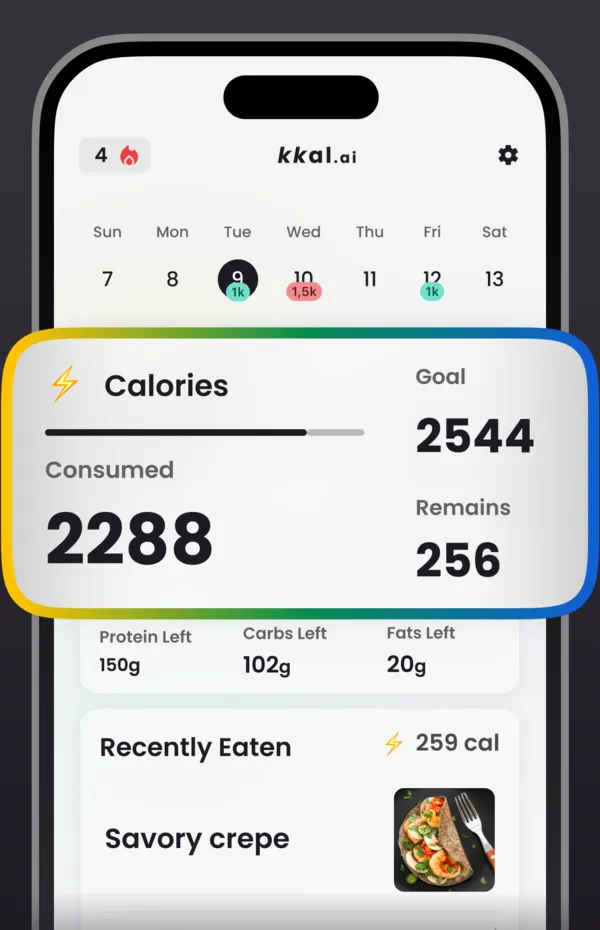
Common mistakes when counting macros
- Mixing up dry and cooked weight. Weigh the food in the same state as the entry you choose. Logging 150 g of cooked buckwheat as dry buckwheat almost quadruples its calories.
- Reading a label per serving as per 100 g. Many packs give both columns; check which one you copy.
- Leaving out oil, sauces and drinks. Cooking fat, mayonnaise, sweet coffee drinks and juice carry a lot of energy for their size.
- Chasing perfect grams every day. Being a few grams over on fat and under on carbs changes little. A protein target that you reach most days and calories that average out over the week are enough.
Which macro split to choose
There is no single correct ratio. The World Health Organization advises that for most adults carbohydrates make up about 45–75% of daily energy, total fat at least 15% and no more than about 30%, and protein about 10–15%, which it describes as generally sufficient. It also notes that people building or keeping significant muscle mass, such as athletes, may need more than 15% from protein. The ranges overlap with the US ones, so you have room to choose by preference and goal.
In practice: if you are eating in a deficit, keeping protein toward the higher end helps meals stay filling. If you train hard, make sure carbs are high enough to fuel the sessions. If you prefer richer food, move a few percent from carbs to fat, but keep saturated fat low. For a day already built around a high protein target, see the high-protein meal plan; for a balanced example, the 1,800 kcal menu lists every portion with its macros. What protein, fat and carbs do in the body is covered in macronutrients explained.
When to get personal advice
Macro targets from calculators are estimates for healthy adults. Talk to a doctor or registered dietitian before setting your own targets if you have kidney disease, diabetes or another condition that affects your diet, are pregnant or breastfeeding, are under 18, or have a history of disordered eating. If tracking grams makes you anxious, track calories and protein only, or take a break.